




Medically reviewed for informational accuracy | Last updated: May 2026
The short answer
Most antifungal comparisons come down to one question: same active or different? With Terrasil and Lamisil AT, the answer is different. Terrasil uses clotrimazole 1%. Lamisil AT uses terbinafine hydrochloride 1%. They work through distinct mechanisms, cover slightly different conditions, and have meaningfully different treatment profiles.
But here’s what Lamisil does significantly different, as well: it has a synthetic base with nothing in it designed to support your skin.
Lamisil AT is a cream built around a single goal — eliminating the fungus. It does that effectively. What it doesn’t do is address the itch, the dryness, the cracking, the slow recovery, or the damaged skin barrier left behind. That’s not a failure of the active ingredient. It’s a failure of the formulation around it.
Terrasil, on the other hand, is an ointment built around a different philosophy entirely. Same category of treatment, completely different support system — clotrimizole 1% as the clinically proven active ingredient, formulated with high-quality natural botanicals, no synthetic fillers, and patented Activated Minerals® technology formulated to help your skin recover from the infection, not just survive it.
At a glance: Terrasil vs. Lamisil AT
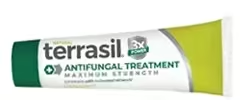 Terrasil® Antifungal Treatment MAX |  Lamisil® AT | |
|---|---|---|
Active Ingredient | Clotrimazole 1% | Terbinafine hydrochloride 1% |
How it works | Inhibits ergosterol synthesis — disrupts the fungal cell membrane | Inhibits squalene epoxidase — causes toxic squalene buildup that kills the fungus |
Action type | Fungistatic / fungicidal depending on concentration and organism | Fungicidal |
Forumulation type | Ointment — a little goes a long way | Cream — may require more product use |
Skin contact duration | Longer-lasting — less re-application. Ointment base forms a protective layer that stays on skin | Shorter — cream base absorbs and disperses faster |
Conditions covered | Athlete’s foot, jock itch, ringworm, various tinea skin infections (excluding nails), external yeast infections | Athlete’s foot, jock itch, ringworm |
Yeast infection coverage | Yes — effective against Candida (external use) | No |
Application | As directed | As directed (athlete’s foot: twice daily 1–2 weeks; jock itch/ringworm: once daily 1 week) |
Inactive base | Natural botanicals: beeswax, organic coconut oil, jojoba oil, MCT oil, peppermint oil, sage oil, tea tree oil, witch hazel | Synthetic fillers: benzyl alcohol, cetyl alcohol, cetyl palmitate, isopropyl myristate, polysorbate 60, sodium hydroxide, stearyl alcohol, water |
Skin-soothing support | High-quality natural botanicals formulated to soothe, moisturize, and protect skin during recovery | None beyond the antifungal active |
Proprietary healing tech | Patented Activated Minerals® — formulated to support skin’s natural healing process | None |
Parabens / preservatives | Free of parabens and harmful preservatives | Contains synthetic preservatives including benzyl alcohol |
Skin support approach | Skin recovery support formulated to help restore healthy skin | “Prevents recurrence for up to 3 months” (marketing claim) |
Both products have different antifungal active ingredients, and different formulation around it — hence, what it does for your skin is where they part ways.
Athlete’s foot, jock itch, ringworm, and more — one family of fungi, multiple addresses
Before comparing the products, it helps to understand what they’re both targeting. Athlete’s foot, jock itch, and ringworm aren’t three distinct diseases. They’re the same family of fungal infection — dermatophytosis — presenting in different locations on the body.1 The organisms responsible are dermatophytes: fungi that thrive in warm, moist environments and feed on keratin, the protein in your skin, hair, and nails.
- Athlete’s foot (tinea pedis) — between the toes and on the soles
- If you’re unsure whether a rash is actually ringworm, understanding the typical appearance and progression can help you identify it earlier.
- Jock itch (tinea cruris) — groin, inner thighs, buttocks
- Ringworm (tinea corporis) — torso, arms, legs
- Tinea Versicolor (tinea versicolor) — patches of skin that become lighter or darker than the surrounding area, most commonly on the chest, back, shoulders, and upper arms
- Unlike ringworm and athlete’s foot, tinea versicolor often presents as changes in skin pigmentation rather than a circular rash.
- Unlike ringworm and athlete’s foot, tinea versicolor often presents as changes in skin pigmentation rather than a circular rash.
Both Terrasil and Lamisil AT are designed to treat this same family of organisms. The difference in active ingredient isn’t about which infection you have — it’s about which antifungal mechanism you’re delivering, and what else arrives with it.
For a full breakdown of how these conditions present and how to tell them apart, see: Jock Itch vs. Ringworm vs. Yeast Infection: How to Tell the Difference and How to Identify Tinea Infections.
Terbinafine vs. clotrimazole: how they’re different and what that means for you
This is the part most comparison articles skip. It’s worth understanding.
In the most simplistic terms, think of the fungus like an unwanted guest who keeps growing and spreading.
Terbinafine poisons the guest directly — it stops the fungus from making something it needs to survive, causing a toxic buildup that kills it outright.
Clotrimazole takes a different approach — it breaks down the fungus’s protective outer wall, leaving it exposed and unable to grow or spread until your body clears it out.
Two different ways of dealing with the same problem. Both work.
In scientific terms, read exactly how each active ingredient works below.
How terbinafine works
Terbinafine is an allylamine antifungal.2 It works by inhibiting squalene epoxidase, an enzyme the fungus needs to produce ergosterol — the structural component of its cell membrane. When squalene epoxidase is blocked, squalene builds up inside the fungal cell to toxic levels. That buildup is what kills the organism. Terbinafine is fungicidal — it kills the fungus directly.
How clotrimazole works
Clotrimazole is an azole antifungal.3 It works further along the same pathway — inhibiting lanosterol 14α-demethylase, another enzyme required for ergosterol production. Without ergosterol, the fungal cell membrane becomes permeable and the cell can no longer function. At standard 1% OTC concentrations, clotrimazole is fungistatic against most dermatophytes — meaning it halts fungal growth and reproduction, allowing the body’s own immune response to clear the infection.
Does fungicidal vs. fungistatic matter in practice?
It’s a reasonable question. Lamisil’s marketing leans on terbinafine’s fungicidal action — the implication being that killing the fungus directly is superior to inhibiting its growth. In a clinical setting, the distinction is more nuanced.
For the dermatophyte infections most people are treating — athlete’s foot, jock itch, ringworm — both mechanisms are well-established and clinically effective.4 Treatment outcomes depend far more on consistent application and proper skin prep than on which mechanism is used. A fungistatic agent applied correctly, to a clean dry surface, every day, will outperform a fungicidal agent applied inconsistently to unprepared skin.
What the fungicidal vs. fungistatic debate doesn’t address at all is what happens to your skin in the process. Neither mechanism does anything for the cracked, irritated, moisture-stripped skin that a fungal infection leaves behind. That’s a formulation question — and it’s where the real difference between these two products lives.
What Lamisil AT claims — and what those claims actually mean
“#1 doctor recommended athlete’s foot brand”
This is a survey-based marketing claim. When healthcare providers are asked which athlete’s foot brand they recommend most, Lamisil comes out on top. That reflects the brand’s market presence and the clinical familiarity of terbinafine — not an evaluation of what’s in the formula beyond the active ingredient.
Terrasil is doctor recommended and dermatologist tested — a clinical testing designation based on actual application to human subjects, evaluated for adverse reactions and tolerability. Those are substantiated safety and efficacy claims, not survey results. They reflect the same standard that doctors apply when recommending any topical treatment: does it work, and is it safe for the skin.
“Prevents recurrence for up to 3 months”
This claim refers to terbinafine’s pharmacological persistence in the stratum corneum — the outermost layer of skin.5 After treatment ends, residual terbinafine remains in the skin at concentrations that may continue to inhibit fungal regrowth. It’s a genuine pharmacological property, not pure marketing.
What it doesn’t address is the condition of the skin itself during and after treatment. Recurrence prevention is meaningful. But if your skin is still dry, cracked, and stripped of its natural barrier at the end of treatment, it remains vulnerable regardless of residual antifungal activity. Healthy, intact skin is its own best defense against reinfection. Terrasil’s formulation is built around restoring that.
Cream vs. ointment: the formulation type difference that most people overlook
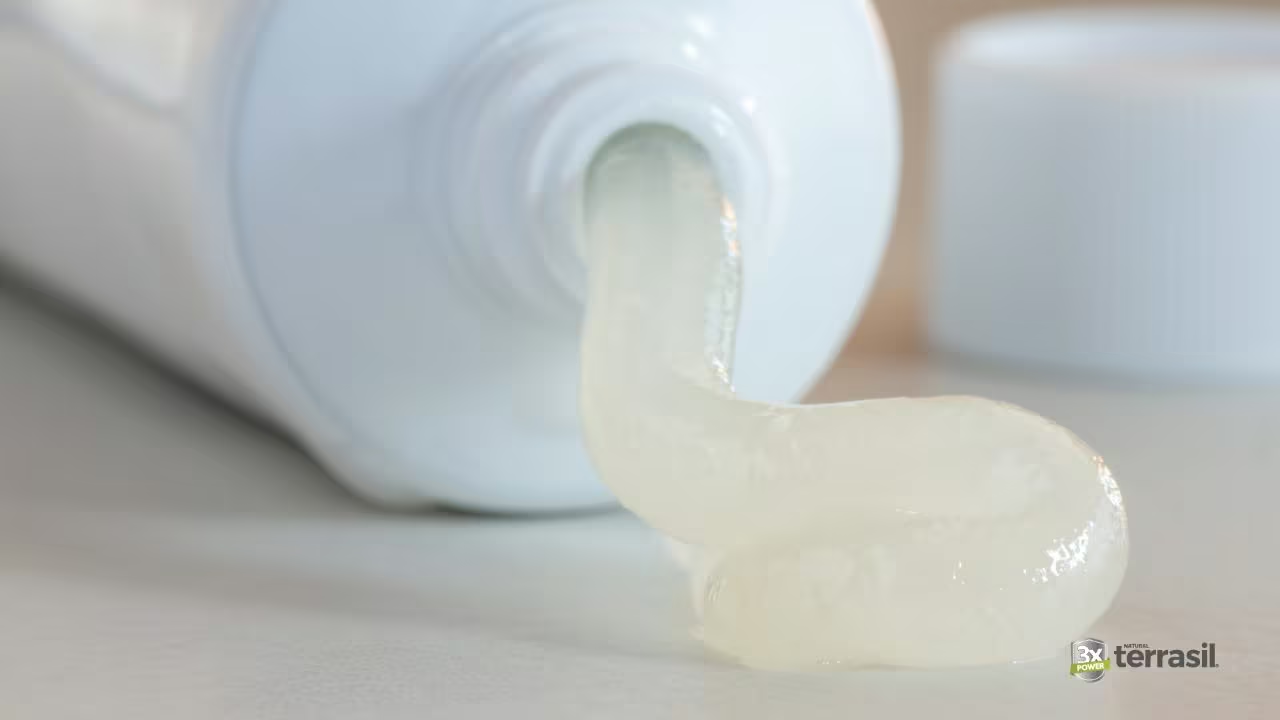
Lamisil AT only comes as a cream. Terrasil is an ointment. For many people this feels like a cosmetic distinction — a matter of texture preference. It isn’t.
Creams are water-based emulsions. They absorb quickly, feel light on the skin, and disperse relatively fast after application.6 That fast absorption is often marketed as a benefit — “non-greasy,” “quick-drying.” But for a medicated product, faster absorption also means less time in active contact with the skin surface.
Ointments are oil-based. They form an occlusive layer on the skin that stays in place, slows water loss, and keeps the formula — active ingredient, botanicals, and all — in sustained contact with the affected area.7 Dermatology research consistently supports ointments as more effective than creams at maintaining skin barrier function and water retention, particularly when skin is already compromised.8
For a fungal infection that has left skin dry, cracked, and irritated, an ointment isn’t just more comfortable — it’s doing more work. Every application of Terrasil delivers the antifungal active in a formula that simultaneously seals in moisture, keeps the skin protected, and maintains sustained coverage. Lamisil’s cream absorbs, disperses, and moves on.
A small amount of ointment goes a long way. Apply a thin, even coat to the affected area and surrounding skin, let it settle for two to three minutes before dressing, and allow the area to breathe. Loose, breathable cotton clothing over the treated area — never an airtight bandage, which traps the moisture and warmth that fungi thrive in.
What’s actually in the formula: natural botanicals vs. synthetic fillers
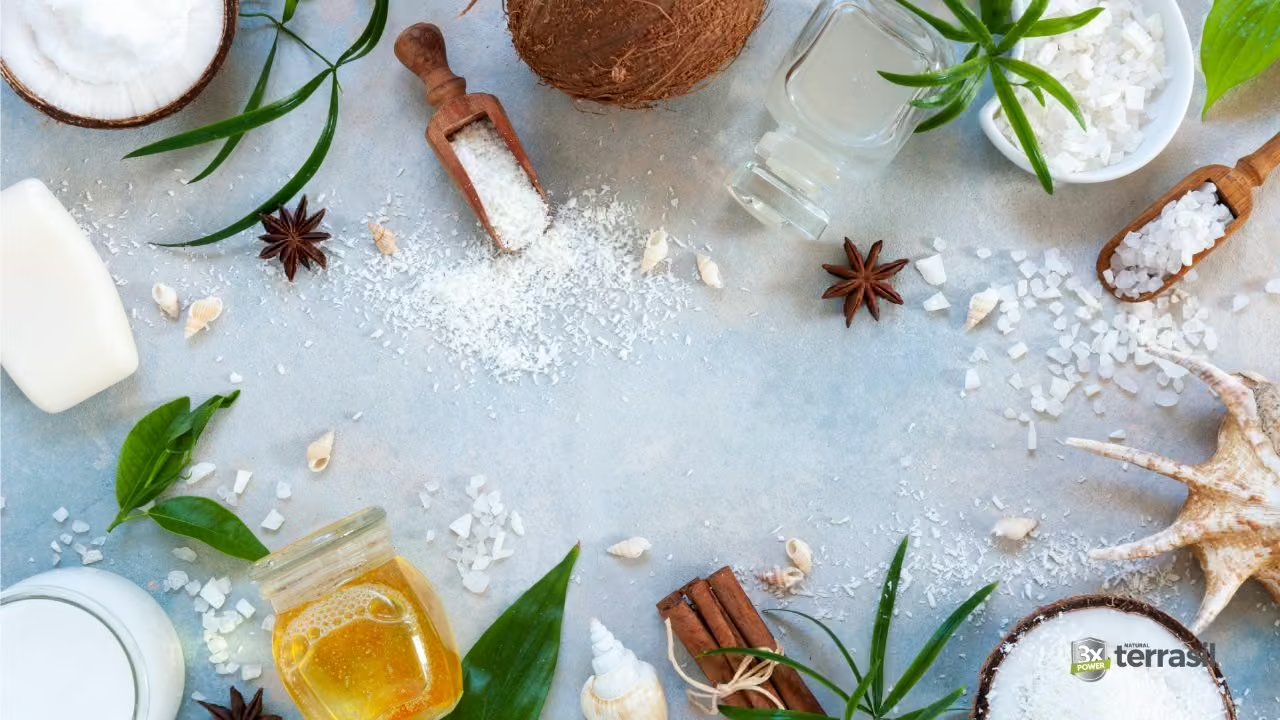
The active ingredient is a fraction of any topical product. The rest of the formula — the inactive ingredients — determines how that active is delivered, how the product feels, and what it does or doesn’t do for the skin beyond killing the fungus.
Terrasil® MAX — Inactive ingredients (natural botanicals) | Lotrimin® AF — Inactive ingredients (synthetic base) |
|---|---|
Beeswax | Benzyl alcohol |
Organic coconut oil | Cetyl alcohol |
Jojoba oil | Cetyl palmitate |
MCT oil | Isopropyl myristate |
Cottonseed oil | Polysorbate 60 |
Peppermint oil | Purified water |
Sage oil | Soldium hydroxide |
Tea tree oil | Sorbitan monostearate |
Witch hazel | Stearyl alcohol |
Patented Activated Minerals® |
Lamisil AT’s base is a standard synthetic pharmaceutical cream. Terrasil’s is a curated profile of natural botanicals chosen for what they do for skin.
Lamisil AT: a functional synthetic base, nothing more
Lamisil AT’s inactive ingredients are a conventional pharmaceutical cream formulation. Benzyl alcohol, cetyl alcohol, cetyl palmitate, isopropyl myristate, polysorbate 60, stearyl alcohol — these are emulsifiers, stabilizers, and penetration enhancers. They hold the formula together and carry terbinafine to the skin. That is their entire purpose.
None of them soothe. None of them moisturize. None of them support skin recovery. Benzyl alcohol is a preservative that can cause irritation in sensitive skin. The rest are there for formulation stability, not skin benefit. When the antifungal work is done, Lamisil’s formula has nothing left to offer.
Terrasil: a botanical support system built around the antifungal
Every inactive ingredient in Terrasil was chosen for a reason beyond formula stability:
- Moisture restoration. Organic coconut oil and jojoba oil
- Deeply nourishing oils that help rebuild the skin barrier fungal infections disrupt, restoring flexibility and softness to cracked, dry skin
- Protective coverage. Beeswax and MCT oil
- Create the occlusive layer that keeps active ingredients working and prevents moisture loss between applications
- Natural antimicrobial and anti-inflammatory support. Tea tree oil
- Well-studied for its role in supporting skin health during and after infection
- Cooling relief. Peppermint oil
- Addresses the itch and burning sensation directly, providing comfort while the antifungal does its work
- Anti-inflammatory and astringent. Sage oil and witch hazel
- Calm redness, irritation, and surface inflammation — the visible aftermath of fungal infection that the active ingredient alone doesn’t address
This isn’t a luxury formulation. These are functional ingredients addressing the real-world symptoms of fungal infection — the discomfort, the irritation, the slow and incomplete recovery that a synthetic base simply cannot touch.
What Lamisil doesn’t have: Terrasil’s patented Activated Minerals®
There is one element of Terrasil’s formulation that has no parallel in any Lamisil product — or in any other OTC antifungal on the market.
Terrasil’s patented Activated Minerals® technology is a proprietary blend developed through over a decade of formulation research.9 These nutrient-rich minerals are designed to work alongside the antifungal active to support the skin’s own regenerative process — supports skin repair, and helping reduce the discoloration and scarring that stubborn or prolonged fungal infections can leave behind.
Lamisil kills the fungus and relies on your skin to do the rest. Activated Minerals® is formulated to actively support that recovery — not wait for it.
No Lamisil product contains a comparable technology. Their formula ends at the active ingredient and a synthetic delivery base.
Try Terrasil® Antifungal Treatment MAX
A proven antifungal active in an ointment formulation built to do more than kill fungus — natural botanicals, patented Activated Minerals® technology, and no synthetic fillers. Formulated to soothe, protect, and support your skin’s natural recovery.
Doctor recommended. Dermatologist tested. Hypoallergenic approved. Free of parabens and harmful preservatives.
Available at: Walgreens, CVS, Amazon, Walmart.com, and iHerb.com, and directly at aidanceproducts.com
Which should you choose?
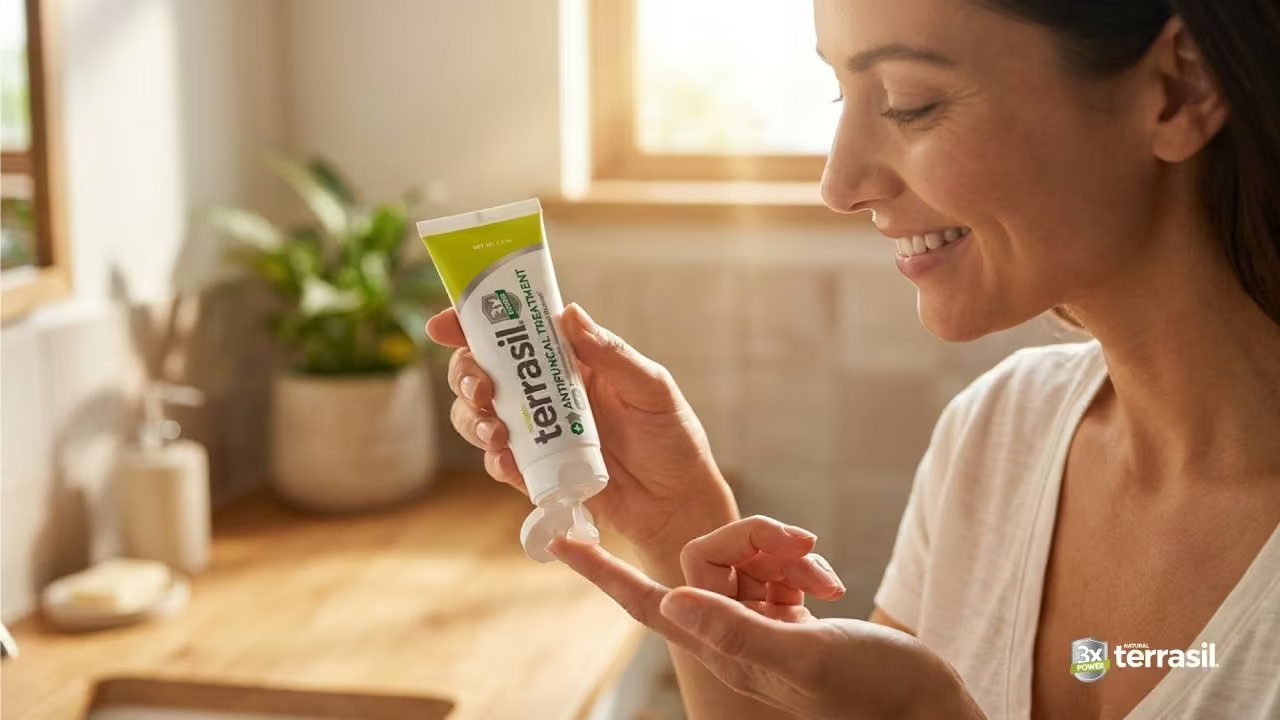
Both products will address the fungal infection. The question is what you want from the formula beyond that.
Consider Lamisil AT if…
- You are treating a mild, short-duration infection and want a fast-absorbing, non-greasy cream texture
- You have used terbinafine before and responded well to it
- You have no sensitivities to synthetic preservatives or standard cream bases
Consider Terrasil if…
- You want an antifungal that also actively works to soothe, restore, and protect your skin — not just eliminate the infection
- Your infection is stubborn, recurring, or has left your skin dry, cracked, discolored, or slow to recover
- You want an ointment formulation that stays on skin longer, requires less re-application, and provides sustained protective coverage
- You prefer a formula free of synthetic fillers, parabens, and harsh preservatives
- You need coverage for external yeast infections in addition to dermatophyte infections — something Lamisil AT does not provide
- You want a product backed by patented healing technology with no equivalent in any competing OTC antifungal
- You want a 90-day money-back guarantee and no-risk trial
- You want the convenience of shopping where you already shop — Terrasil is available at Walgreens, CVS, Amazon, Walmart.com, and iHerb.com, and directly at aidanceproducts.com
Lamisil AT is a well-formulated antifungal. But a well-formulated antifungal is only half the job. Fungal infections don’t just colonize your skin — they damage it. The formula that helps you recover from that damage, not just survive it, is the one worth reaching for.
Getting the most out of Terrasil: the complete antifungal routine
Terrasil Antifungal Treatment MAX is effective on its own. For stubborn, recurring, or particularly uncomfortable infections, pairing it with the Terrasil® Antifungal Cleansing Bar turns a good routine into a complete one.
Step 1 — Cleanse with Terrasil® Antifungal Cleansing Bar
Wash the affected area with Terrasil® Antifungal Cleansing Bar before applying the ointment. Unlike a standard soap, this bar contains clotrimazole 1% as its active ingredient — the same proven antifungal active in the ointment — alongside patented Activated Minerals® and high-quality natural botanicals including olive oil, shea butter, coconut oil, jojoba oil, tea tree oil, and peppermint oil. It gently cleanses while helping maintain a healthy skin environment, so every application of ointment starts on the best possible surface. Many customers report noticeable improvement within a few days of consistent use.‡
Step 2 — Dry thoroughly
Pat the area completely dry before applying the ointment. Do not rush this step. Fungal organisms thrive in moisture — a dry surface gives the active ingredients the conditions they need to work effectively.
Step 3 — Apply a thin coat of Terrasil® Antifungal Treatment MAX
Apply a thin, even layer to the affected area and a small margin of surrounding skin. You don’t need much — Terrasil is an ointment, and a little goes a long way. The ointment base spreads easily and maintains contact with the skin without needing a heavy application. Once applied, allow two to three minutes for the ointment to settle before getting dressed.
Step 4 — Let it breathe. No bandages.
Do not cover the treated area with an adhesive bandage or airtight dressing. Fungal organisms thrive in warm, sealed, moist environments.10 Covering the area recreates exactly those conditions. Instead, wear loose-fitting, breathable cotton clothing over the treated area. For jock itch, avoid tight synthetic underwear. For athlete’s foot, wear clean cotton socks and well-ventilated shoes. If the area is subject to constant friction from clothing, a breathable — not airtight — dressing may be appropriate. When in doubt, consult your healthcare provider.
Consistency is what resolves fungal infections. A thin coat, applied correctly, to a clean dry surface, every day — paired with the cleansing bar — will deliver better results than an occasional heavy application.
‡ Out of customers who reported improvement within 1 to 7 days, the average time of improvement was 3.7 days. Results may vary.
Frequently Asked Questions
- Jock Itch vs. Ringworm vs. Yeast Infection: How to Tell the Difference
- What Does Ringworm Look Like?
- Yeast Infection Symptoms on the Skin
- How Long Does Ringworm Last?
- Why Ringworm Keeps Coming Back
- What Is the Best Antifungal Cream?
- Best Athlete’s Foot Treatment
- How to Identify Tinea Infections
Sources
- Centers for Disease Control and Prevention. Fungal Diseases — Ringworm. Retrieved May 2026 from https://www.cdc.gov/fungal/diseases/ringworm/index.html
- Ryder, N.S. (1992). Terbinafine: mode of action and properties of the squalene epoxidase inhibition. British Journal of Dermatology, 126(Suppl 39), 2–7. Retrieved May 2026 from https://pubmed.ncbi.nlm.nih.gov/1390114/
- MedlinePlus. Clotrimazole Topical. U.S. National Library of Medicine. Retrieved May 2026 from https://medlineplus.gov/druginfo/meds/a601027.html
- Gupta, A.K. & Foley, K.A. (2015). Antifungal treatment for pityriasis versicolor. Journal of Fungi, 1(1), 13–29. Retrieved May 2026 from https://pmc.ncbi.nlm.nih.gov/articles/PMC5770015/
- Faergemann, J. et al. (1994). Pharmacokinetics of terbinafine in the stratum corneum after a single oral dose. British Journal of Dermatology, 130(Suppl 43), 7–11. Retrieved May 2026 from https://pubmed.ncbi.nlm.nih.gov/8186136/
- SkinKraft. Ointment vs Cream: What Makes Them Different? Retrieved May 2026 from https://skinkraft.com/blogs/articles/ointment-vs-cream
- WeDerm. Lotion vs. Cream vs. Ointment: Which to Use When. Retrieved May 2026 from https://www.wederm.com/blog/lotion-vs-cream-vs-ointment-which-to-use-when/
- Lodén, M. (2018). The Role of Moisturizers in Addressing Various Kinds of Dermatitis: A Review. PMC/NCBI. Retrieved May 2026 from https://pmc.ncbi.nlm.nih.gov/articles/PMC5849435/
- Aidance Scientific. Terrasil® Antifungal Treatment MAX — Product Information. Retrieved May 2026 from https://www.aidanceproducts.com/terrasil-max-anti-fungal-treatment
- 1ScienceInsights. Should You Cover Up Ringworm With a Bandage? Retrieved May 2026 from https://scienceinsights.org/should-you-cover-up-ringworm-with-a-bandage/
- DermNet NZ. Tinea Infections. Retrieved May 2026 from https://dermnetnz.org/topics/tinea
- Mayo Clinic. Ringworm (tinea corporis). Retrieved May 2026 from https://www.mayoclinic.org/diseases-conditions/ringworm-body/symptoms-causes/syc-20353780
Disclaimer: This article is for informational purposes only and does not constitute medical advice. Terrasil® Antifungal Treatment MAX is intended for external use only. If your symptoms persist beyond four weeks, worsen, or involve the face, nails, or scalp, consult a licensed healthcare provider. These statements have not been evaluated by the Food and Drug Administration. This product is not intended to diagnose, treat, cure, or prevent any disease.